The Challenge
A client needed a remote sensing platform that could operate unattended in off-grid environments for years at a time. The system had to capture LIDAR range data and camera imagery, then backhaul the data over a cellular link — all while running on a small primary-cell battery supplemented by a solar panel. Every microwatt mattered.
Commercial off-the-shelf solutions either consumed too much power for multi-year operation or lacked the sensor flexibility the application demanded. A custom hardware and firmware platform was the only path forward.
Our Approach
System Architecture
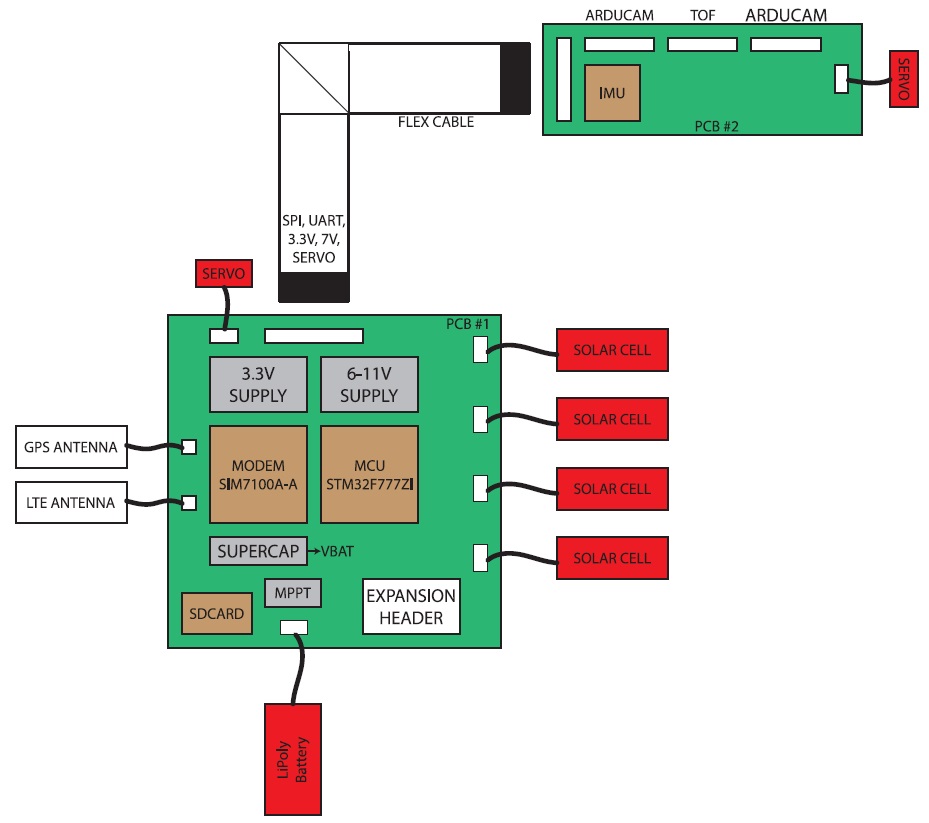
We designed a two-board system — a main board and a camera/sensor board — connected via FPC cables. The main board carries the STM32F7 microcontroller, a SIM7100A 3G cellular modem, SD card storage, a peak-power solar tracker, supercapacitor-backed sleep circuitry, and interfaces for pan/tilt servos and a LIDAR module. The camera board hosts an ArduCam module for low-frame-rate image capture.
Ultra-Low-Power Design
The power budget was the single hardest constraint. At 24 captures per day on a 100 W·hr primary cell, the system needed to last three years — meaning average power draw had to stay well below 4 mW.
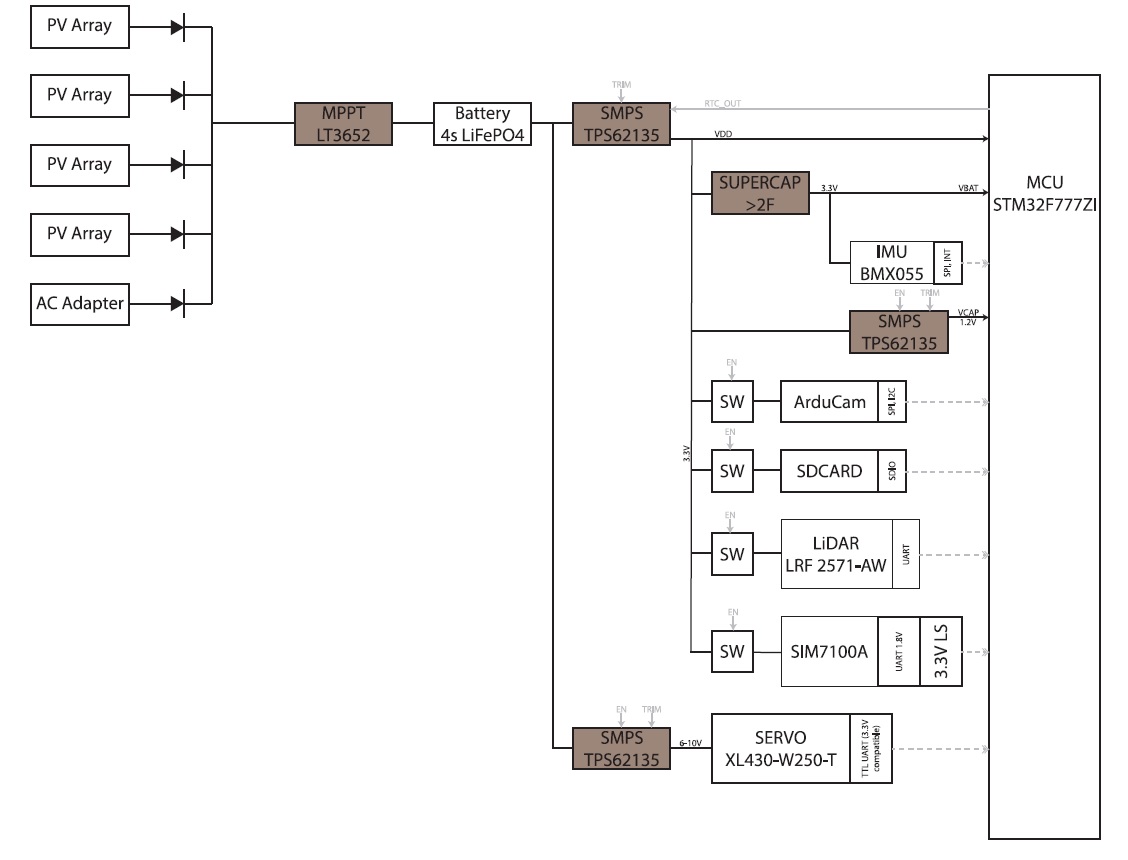
To achieve this, all switching regulators can be fully shut down between capture events. A supercapacitor keeps only the MCU's RTC and an onboard IMU alive during deep sleep, enabling both timed wake-up and motion-interrupt wake-up. The modem — by far the largest power consumer — boots only a few times per day; photos are cached to the SD card in the meantime to minimize cellular on-time.
Hardware Design
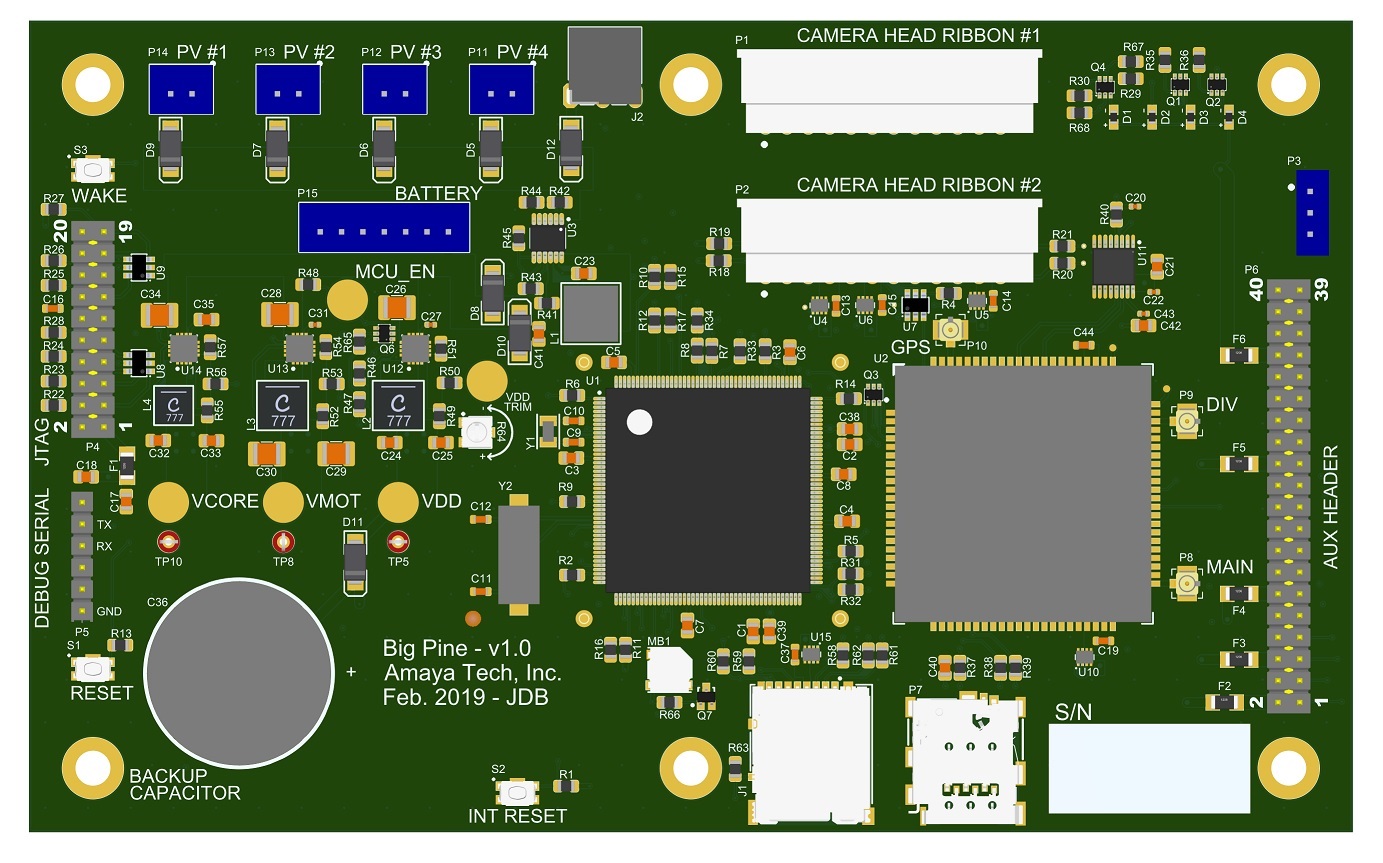
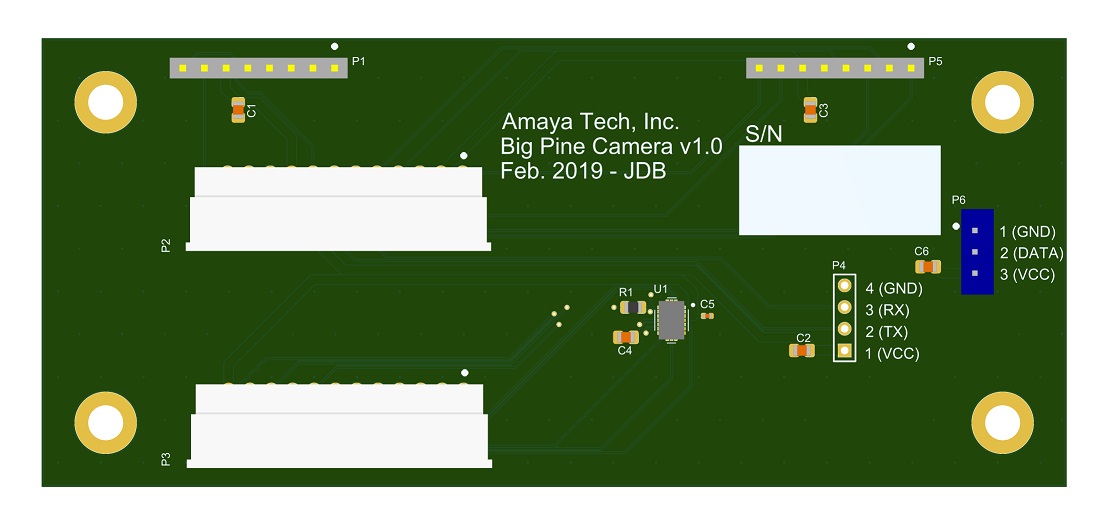
Both boards were designed from schematic through layout in-house. The main board integrates a complex power tree — solar input with MPPT, battery charging, supercap management, and multiple switchable rails — alongside high-speed digital interfaces for the modem and SD card. The camera board keeps the optical path short and isolated from digital noise.
Firmware
Firmware was developed in C/C++ on the STM32 HAL. The architecture is event-driven: the MCU wakes on an RTC alarm or IMU interrupt, powers up the necessary peripherals, captures and stores data, and optionally initiates a modem session to upload cached payloads. Each wake cycle is profiled to stay within a strict energy envelope.
Results
- 3+ year projected battery life on a single 100 W·hr primary cell at 24 captures per day, validated by bench power profiling
- Sub-second wake-to-capture latency, ensuring the system doesn't miss transient events triggered by the IMU
- Reliable 3G backhaul via the SIM7100A modem with automatic retry and SD-card spooling for coverage gaps
- Modular sensor interface supporting LIDAR, ArduCam, and pan/tilt servos over a single FPC interconnect
Technical Highlights
- Peak-power solar tracker extends effective battery life significantly in deployments with even partial sun exposure
- Supercapacitor-backed sleep domain eliminates regulator quiescent draw, dropping sleep-mode consumption to the low-microamp range
- SD card caching decouples capture rate from modem uplink schedule, allowing burst uploads that amortize the modem's high boot-up energy cost
- The design is open-source, including schematics, PCB layout, and proof-of-concept firmware
Client Impact
The platform gave the client a flexible, field-proven foundation for remote environmental monitoring. Because the hardware and firmware are open-source, their internal engineering team can extend sensor support and tune the power profile for new deployment scenarios without vendor lock-in.